

Aztecs: Rise Society and Enduring Legacy of a Mesoamerican Empire
The Aztecs remain one of the most fascinating civilizations in world history. Their rapid rise from a small group of people to rulers of a vast empire in central Mexico captures the imagination of scholars and casual readers alike. This article explores the origins society beliefs economy art and eventual fall of the Aztecs while highlighting why their legacy still matters today.
Origins and Migration
The people we call the Aztecs are most accurately identified as the Mexica. According to their own accounts and later colonial sources the Mexica migrated into the Valley of Mexico from the north and settled on islands in Lake Texcoco. From these beginnings they founded the city that would become the imperial capital known as Tenochtitlan. Archaeology and ethnohistory show a complex process of migration assimilation and political alliance that allowed the Aztecs to gain power among older city states in the region.
Society and Political Structure
Aztec society was hierarchical yet flexible enough to absorb new elites from conquered peoples. The ruler known as the huey tlatoani held supreme power while a class of nobles controlled land military and high office. Commoners worked as farmers artisans traders and soldiers. Slavery existed but it operated under social rules that allowed some slaves to own property or regain freedom. Alliances between powerful city states such as Texcoco and Tlacopan enabled the Aztecs to establish a tributary empire that extracted resources while leaving much local autonomy intact.
Religion and Ritual Life
Religion was central to Aztec life and shaped political decisions military campaigns and public festivals. The Aztecs worshiped a pantheon dominated by gods such as Huitzilopochtli the god of war and the sun and Tlaloc the rain god. Rituals often involved elaborate ceremonies public displays and in some cases human sacrifice. These practices reflected a cosmology in which cyclical time and reciprocal relations with the gods required offerings to ensure fertility health and victory in war. Priests served as mediators between the people and the divine and controlled education and calendar knowledge that were essential for agriculture and governance.
Economy and Trade
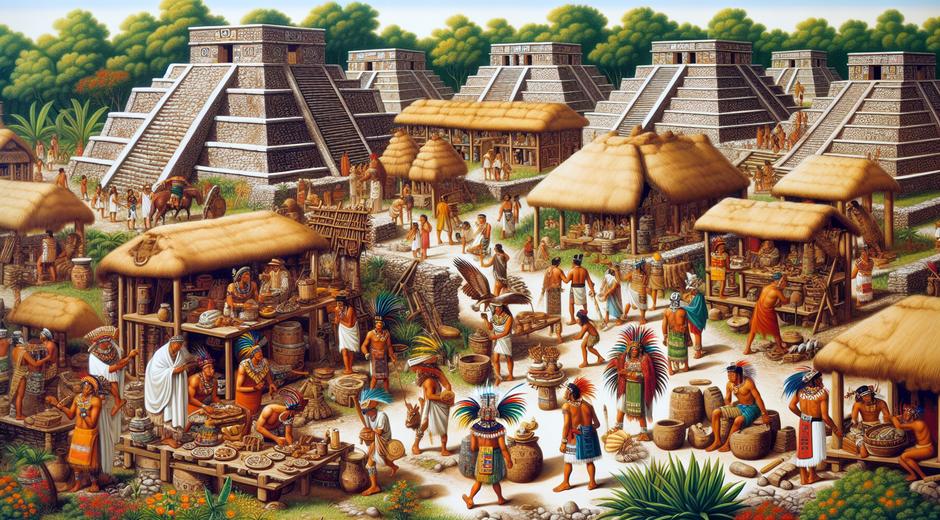
The Aztec economy relied on agriculture craft production and long distance trade. Chinampa agriculture on artificial islands in Lake Texcoco produced abundant harvests of maize beans squash and other staples. Markets such as the one at Tlatelolco were vibrant centers where merchants traded goods from across Mesoamerica including obsidian cacao textiles and luxury goods. Tribute from subject cities provided a steady flow of resources that sustained the capital and supported large standing armies and public works.
Art Architecture and Science
Aztec artistic production ranged from monumental architecture and stone sculpture to feather work and codex painting. Tenochtitlan contained grand temples palaces and causeways that impressed visitors with their scale and engineering. The Aztecs developed sophisticated calendrical systems combining ritual and solar cycles. Medical knowledge botanical understanding and military engineering also show high levels of practical expertise. Artistic styles emphasized symbolic imagery that communicated political authority religious meaning and social identity.
Conquest and Collapse
The arrival of Spanish forces under Hernan Cortes in the early sixteenth century intersected with political rivalries disease and shifting alliances that led to the rapid collapse of the Aztec empire. Superior European weaponry and tactics were one factor yet the impact of epidemics introduced by Europeans devastated urban populations and undermined the ability to resist. Indigenous allies who had grievances against Aztec rule played a crucial role in the Spanish victory. The fall of Tenochtitlan in 1521 marked the end of imperial authority yet many elements of Aztec culture endured by adapting to new colonial structures.
Legacy and Cultural Influence
The Aztecs left a lasting legacy in language art cuisine and urban form. Nahuatl the language of the Aztecs contributed many words to global languages and remains spoken by communities today. Staple foods such as maize beans tomatoes and chili shaped global diets and culinary traditions that spread well beyond the Americas. Architectural ruins sculptures and codices provide invaluable evidence for understanding pre colonial life and beliefs. Museums and cultural institutions continue to study and display Aztec artifacts that inform public understanding of their achievements and complexity.
Why the Aztecs Matter for Modern Readers
Studying the Aztecs helps modern readers appreciate the diversity of human political economic and spiritual systems. Their innovations in agriculture urban planning and market exchange offer lessons about resilience and adaptation in densely populated environments. Learning about Aztec religious thought reveals different ways societies make sense of mortality duty and cosmic order. For those researching ancient civilizations or comparing political systems visiting a dedicated history resource can provide broader context and related articles about neighboring cultures and long term processes. For a comprehensive collection of articles and timelines consult chronostual.com to explore connected topics and primary source discussions.
Further Reading and Resources
For readers interested in more applied or commercial perspectives on cultural heritage management and education there are forums and guides that discuss how museums and institutions promote historical learning. A recommended resource for community engagement best practices and outreach strategies is available at BusinessForumHub.com which offers case studies and discussions relevant to heritage practitioners and educators.
Conclusion
The story of the Aztecs is one of rapid growth sophisticated organization and dramatic change. Their achievements in agriculture art political organization and knowledge continue to inform our understanding of human creativity and resilience. By studying the Aztecs historians archaeologists and readers gain insight into the dynamics of empire the role of ritual and the ways that cultures adapt to crisis. Exploring their legacy through careful research and public education helps preserve a nuanced view of a civilization that shaped the future of an entire region.