

Spanish Armada
The Spanish Armada stands as one of the most dramatic episodes in early modern European history. When a vast fleet set sail from Spain in 1588 with the aim of invading England and ending the rule of Queen Elizabeth I it set in motion events that reshaped naval strategy diplomacy and national identity across the continent. This article explores the origins forces key moments and lasting consequences of the Spanish Armada while offering clear context for readers seeking a deep historical overview.
Origins and Causes of the Conflict
The Spanish Armada did not arise from a single dispute. Instead it emerged from a blend of religious rivalry dynastic tension and competition for overseas wealth. Spain under King Philip II viewed Protestant England as a safe haven for rebels and privateers who attacked Spanish shipping. The excommunication of Elizabeth I by the Pope in 1570 gave Philip a pretext to restore Catholic rule in England by force if necessary.
English support for the Netherlands which was fighting to free itself from Spanish rule further inflamed relations. English privateers targeted Spanish treasure galleons coming from the New World and returned both loot and outrage to London. Over time Philip II came to believe that a decisive naval campaign followed by the transport of a land army could topple the English crown and secure Catholicism across the British Isles.
Composition and Strategy of the Armada
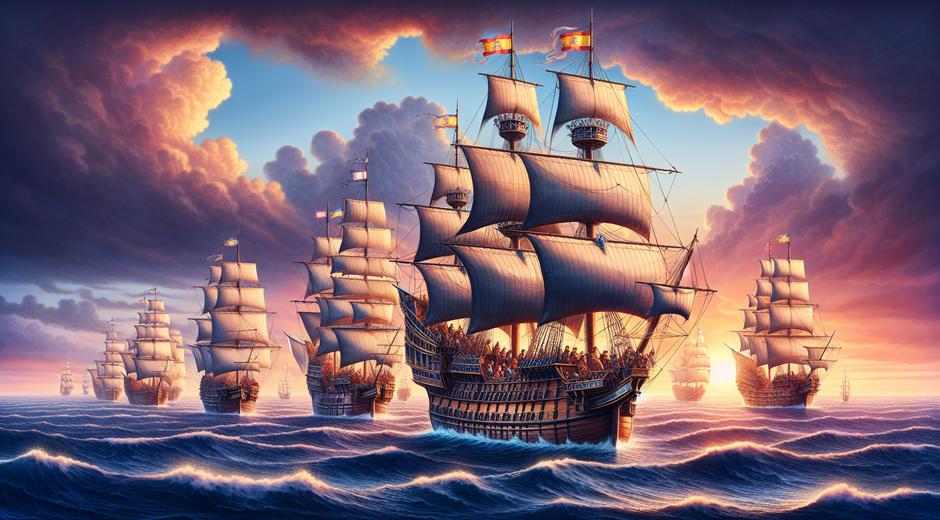
The Spanish Armada was a complex assembly of ships soldiers sailors and supplies. The plan called for a large fleet to escort an invasion force from Flanders across the English Channel to a rendezvous point where Spanish troops would disembark and march on London. Command was placed under the experienced Duke of Medina Sidonia who faced the daunting task of navigating variable weather and coordinating with army commanders on land.
Spain relied on heavy galleons built for carrying cannon and treasure over long distances. England fielded smaller faster ships manned by crews trained in gunnery and agile tactics. English commanders favored hit and run tactics using speed and maneuverability to avoid boarding actions and to inflict damage at a distance. These differences in naval doctrine played a key role in the outcome of the campaign.
The Campaign of 1588
In July 1588 the Armada left Spain and made its way up the Atlantic coast. Early encounters revealed the limits of Spanish plans. English ships harassed the fleet and sought to break its formation. The decisive moment often recalled by historians did not involve a single great battle but a combination of relentless sea fighting and the weather. English fireship attacks at anchor near Calais created chaos forcing the Spanish to cut their anchors and scatter. In the days that followed the fleets clashed in a series of engagements in the Channel that favored English tactics.
Crucially the Armada failed to secure a safe anchorage for the troop transports and to coordinate effectively with the army at Dunkirk. With damage mounting and the risk of being trapped between English naval forces and the shore the Spanish commanders chose to retreat by sailing north around Scotland and then south along the Irish coast. Many ships were wrecked on rocky shores and thousands of men were lost to storms exposure and capture. The once formidable armada returned to Spain but never regained its former power.
Role of Weather and Geography
Weather played a decisive role in the fate of the Spanish Armada. Storms in the North Sea and along the coast of Ireland caused massive damage that compounded losses from combat. The inability to predict and manage the weather was as important as any tactical error. Navigation in unfamiliar northern waters also contributed to the losses on rocks and shoals outside the Spanish planners knowledge.
Geography favored the defenders. The English Channel allowed smaller fast ships to exploit wind and tide. Coastal knowledge gave the English an edge in choosing when and where to strike. Sea conditions and local currents hindered the Spanish capacity to regroup and to protect their transport fleet during the retreat.
Consequences for Spain England and Europe
Although the immediate military loss for Spain was significant the broader consequences were mixed. For England the successful defense became a powerful symbol of national resilience. It boosted morale and helped solidify Elizabethan rule. England gained increased confidence to expand its own maritime ventures and to challenge Spanish dominance in the Atlantic and the New World.
Spain suffered not only ships and men but also a dent to its reputation for invincibility. The failure revealed limits in logistics and coordination for long range military operations. Over the following decades Spain remained a major European power but the Armada campaign signaled a shift in naval balance that opened space for other seafaring nations to expand.
Myths Misconceptions and Modern Assessment
The story of the Spanish Armada entered popular culture and national mythmaking. In England it was portrayed as a clear divine favor for the Protestant cause. Later historians have offered more nuanced readings showing that the English victory depended on a combination of strategy technology leadership and sheer luck. Historians also stress that the Armada was not the end of Spanish maritime power. It represented a failed campaign rather than a sudden collapse.
Modern scholars use primary sources such as letters ship logs and state papers to reconstruct the campaign. They highlight the human cost and note how logistics and communication failures undermined the Spanish plan. New research also examines the role of maritime technology and the evolution of ship design that made smaller more mobile fleets increasingly effective.
Legacy in Naval Doctrine and Culture
The Spanish Armada had a lasting impact on naval doctrine. It underscored the value of gunnery training and ship maneuverability. Navies began to emphasize speed and firepower over boarding actions and heavy armor. The campaign prompted new investments in naval infrastructure and shipbuilding that helped shape the rise of sea based empires.
Culturally the Armada left enduring symbols. Poems chronicles and visual art commemorated the events and shaped the memory of an era. For England it became part of national identity. For Spain it remains a subject of reflection and study. Museums and maritime heritage sites across Europe preserve artifacts and tell the stories of sailors officers and ordinary men caught in a turning point of history.
Where to Learn More
For readers who wish to explore further primary records and well researched narratives the best starting point is a reputable history portal that collects essays source materials and bibliographies. One such resource can be found at chronostual.com where you will discover curated content across eras that places the Spanish Armada in a larger historical framework.
Research into this topic continues to evolve. If you are promoting a project or a museum program or if you seek an authoritative overview for teaching or for publication you might also consider visiting Chronostual.com where curated material supports further study and classroom use.
Conclusion
The Spanish Armada of 1588 remains a pivotal moment in early modern history. It combined naval innovation diplomatic rivalry religious conflict and unpredictable environmental forces to produce an outcome with lasting geopolitical consequences. By studying the Armada we gain insight into the emergence of modern naval strategy the limits of imperial power and the many ways in which weather human decision and technology interact in the forging of history.