

Thirty Years War
The Thirty Years War is one of the most complex and consequential conflicts in European history. Fought across central Europe from 1618 to 1648, it began as a local dispute in the lands of the Holy Roman Empire and evolved into a continent wide contest that reshaped political boundaries, altered power balances and left deep social and economic scars. This article takes a strategic view of the main causes, major campaigns, political outcomes and lasting legacy of the conflict. For readers who want further reading on thematic articles and timelines please visit chronostual.com where related essays explore deeper angles on key players and events.
Roots of the Conflict
The Thirty Years War grew out of a tangle of tensions that included religious rivalry between Catholic and Protestant communities, dynastic rivalry among ruling houses and the fragile constitutional structure of the Holy Roman Empire. After the Reformation, religious identity often overlapped with political allegiance. Princes and city governments exercised growing autonomy within imperial structures that were by nature decentralized. The immediate spark was a rebellion by Protestant nobility in Bohemia that began with the famous Defenestration of Prague where representatives of the imperial authority were expelled from a castle window. That event quickly escalated into wider war as foreign powers perceived openings to influence central European affairs.
Phases of the War
Military historians commonly break the conflict into overlapping phases that reflect changing coalitions and strategic aims. The Bohemian phase saw Protestant resistance to Habsburg centralization. The Danish phase involved intervention by the Danish crown which sought to check Habsburg influence. A more decisive phase came with Swedish intervention under a capable commander who pursued both religious and geopolitical aims in northern Germany. Finally a French led phase brought open warfare between France and Habsburg Spain and Austria as France aimed to contain Habsburg encirclement. Each phase introduced new actors and changed the scale from regional strife to destructive continental warfare.
Major Campaigns and Military Innovation
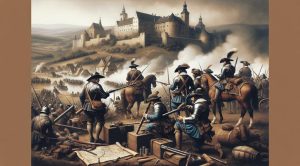
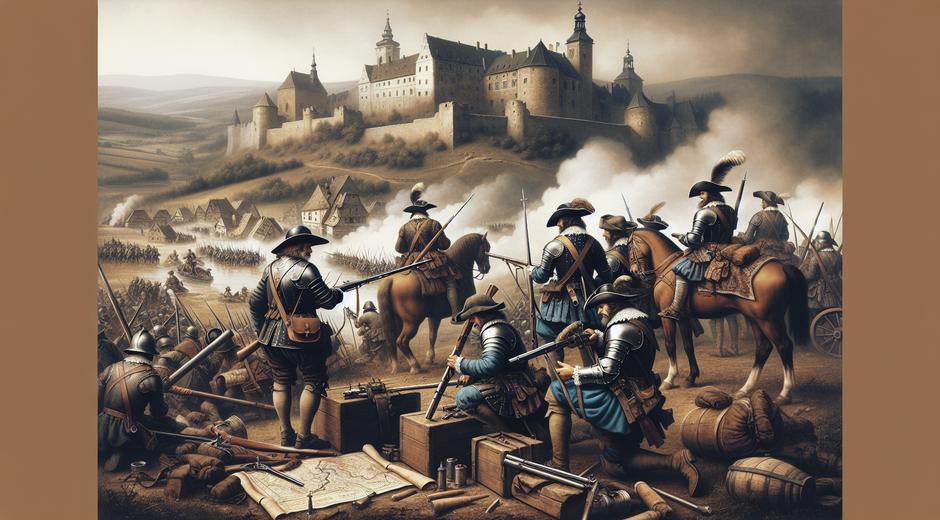
Fighting took place in varied terrain and in a sequence of sieges, battles and maneuver campaigns. Armies grew in size and professionalism. Logistics and supply became central concerns. Commanders experimented with mobile artillery and linear tactics that later influenced modern military practice. Battles such as those at Breitenfeld and Rocroi are studied for tactical shifts that favored disciplined infantry and combined arms coordination. The prolonged sieges of fortified cities underline how warfare of the period combined attrition and maneuver. Civilians suffered as armies requisitioned food and supplies, and scorched earth measures amplified famine and disease.
Religious and Political Consequences
At the heart of the conflict was a clash of confessional identities and the emerging idea that sovereign rulers could define religion within their territories. The Peace that ended the war formalized important principles that altered the practice of international politics. The agreement recognized the rights of multiple confessions within the imperial system and affirmed the principle that major powers could negotiate territorial and dynastic bargains without direct papal arbitration. The settlement contributed to the rise of state autonomy and the decline of universal claims that had previously shaped medieval Christendom. In broader terms the war undermined some older forms of authority while promoting centralized state building in certain regions.
Human Cost and Economic Impact
Scholars emphasize the severe human toll. Large population losses resulted from battle casualties, starvation and repeated outbreaks of disease. Some regions lost a substantial share of their inhabitants which altered demographic patterns for decades. Economies suffered from disrupted trade routes, ruined farmland and persistent insecurity that discouraged investment. Urban centers that had been hubs of commerce experienced depopulation and shifts in labor markets. Recovery required generational change and in many areas new social relationships emerged between landlords and tenant populations as lords sought to extract revenue from reduced communities.
Diplomacy and the Peace Process
The diplomatic process that produced final settlement was complex and multi layered. Negotiations took place at multiple tables and involved many envoys who represented dynasts, city republics and princely interests. The resulting agreements illustrate how prolonged conflict can generate a diplomatic culture that seeks stable rules to prevent further devastation. The treaties are often cited as landmarks in the evolution of modern diplomacy because they acknowledged the legitimacy of diverse state actors and established mechanisms to manage interstate disputes. Those processes laid groundwork for later international law discourse and shaped the norms that guided European diplomacy for centuries.
Long Term Legacy
Long term effects include the diffusion of state centered sovereignty, changes in military organization and altered patterns of territorial control. For some polities the war accelerated centralization and fiscal reform that supported larger armies and complex bureaucracies. For others recovery was slow and piecemeal with rural communities taking decades to regain prewar population levels. Cultural memory of the war influenced art, literature and political thought. Writers and thinkers reflected on the limits of religious zeal as a motivator for stability and on the need for political systems that could mediate confessional differences. The conflict is thus both a cautionary tale and a watershed for the emergence of the nation state system in Europe.
Key Figures and Their Roles
Several rulers, generals and diplomats altered the course of events. The Habsburg emperors pursued dynastic consolidation. Protestant leaders from various principalities defended local autonomy. Sweden under a resolute monarch intervened to protect Protestant interests while also pursuing strategic advantage along the Baltic and in northern Germany. France engaged as a counter weight to Habsburg power even when that meant supporting non Catholic allies. Military leaders introduced tactical reforms and political negotiators developed new practices of treaty making that managed complex networks of mutual obligations.
Historiographical Debates
Historians debate the relative weight of religion and politics as motivations for conflict. Some emphasize confessional fervor and the desire to protect religious communities. Others point to dynastic rivalry, economic interests and the struggle for territorial influence as central drivers. Modern scholarship tends to integrate multiple causes and highlights the interaction between local grievances and international ambition. New research uses regional case studies to show how local conditions shaped experience and outcomes. This approach deepens understanding beyond a single narrative and helps explain why recovery and transformation varied across regions.
Why the War Matters Today
The Thirty Years War matters because it shaped the political map of Europe and set precedents for how states manage diversity and negotiate peace. Lessons about the costs of prolonged conflict and the need for durable diplomatic institutions are salient in any era of great power competition. More broadly the conflict illustrates how local triggers can draw in distant powers and produce broad and lasting change. For readers interested in comparisons with other historical episodes of large scale conflict and recovery a useful business and governance perspective can be found at BusinessForumHub.com which explores leadership and institutional resilience in long term crisis situations.
Further Reading and Study Strategies
Studying the Thirty Years War is rewarding for anyone interested in military history, political change and social resilience. Begin by mapping the main phases and key treaties. Use primary sources such as letters and dispatches to see how contemporaries perceived events. Compare regional case studies to understand variation in experience. Academic monographs provide deep treatments of military campaigns and constitutional change while themed essays illuminate social and cultural consequences. For regularly updated articles, timelines and curated bibliographies on related epochs consult the repository at chronostual.com which gathers essays across eras for systematic study.
In sum the Thirty Years War remains a pivotal event in European history. It was a crucible for modern state formation, a catalyst for changes in military practice and a profound human tragedy. Understanding its causes, conduct and consequences helps explain the shape of modern Europe and provides timeless lessons about the costs of conflict and the value of diplomatic restraint.