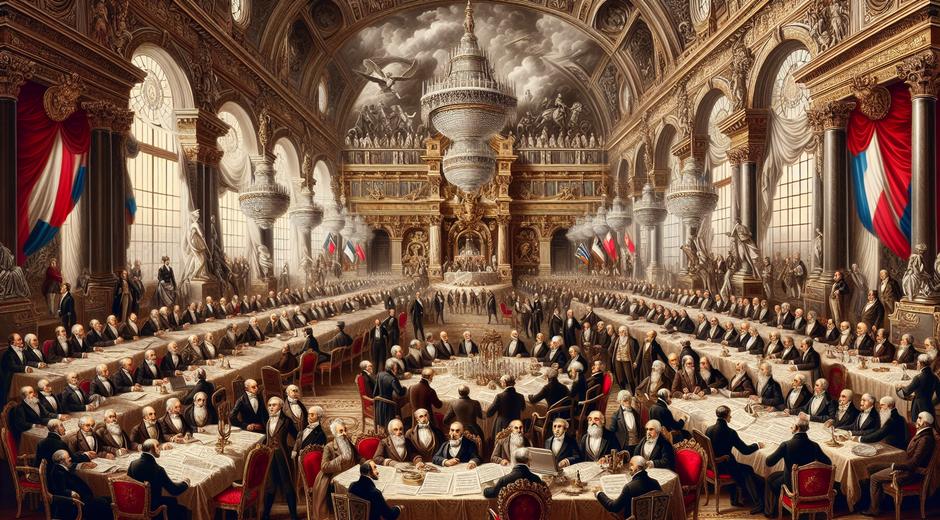


Congress of Vienna
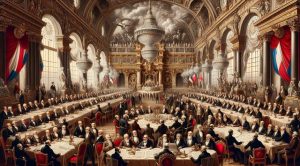
The Congress of Vienna stands as one of the most consequential diplomatic gatherings in modern European history. Convened in 1814 to 1815 after a decade of widespread war and political upheaval, delegates from the major powers of Europe came together in the Austrian capital to negotiate a framework for lasting peace. This article explores the context that produced the Congress of Vienna the main actors the resolutions that emerged and the long term effects of those decisions on the map of Europe and on the practice of diplomacy.
Background and context
Europe in the years before the Congress of Vienna was marked by seismic change. The French Revolution had overturned old dynastic privilege and Napoleon transformed the map of the continent through conquest and administrative reform. By 1814 Napoleon had been defeated and exiled and the powers that had fought him faced the challenge of creating stability without simply restoring the precise order that existed before the revolution.
The phrase Congress of Vienna refers to a series of meetings rather than a single event. The aim was to restore legitimate monarchies to power to redraw borders in ways that would limit future aggression and to create a diplomatic system that could manage conflicts without returning to continental war. Delegates had to balance revenge with restraint legitimacy with practicality and territorial compensation with the desire to avoid permanent resentments.
Key players and their aims
The negotiations at the Congress of Vienna were shaped by personalities as much as by principle. Prince Klemens von Metternich of Austria championed the idea of a conservative order that would suppress revolutionary impulses and defend established monarchies. The Russian Tsar Alexander the First sought gains and influence in Eastern Europe but also imagined a kind of moral leadership for a reformed Europe. Britain represented by Foreign Secretary Viscount Castlereagh emphasized balance of power and maritime security. France while defeated still played a role through skilled diplomacy led by Charles Maurice de Talleyrand who sought to limit the severity of penalties while restoring France to the status of a great power.
Each of these figures brought different priorities to the table. Austria wanted secure borders and a stable Central Europe. Russia wanted territory and prestige. Britain wanted to prevent any single power from dominating the continent and to protect its own trade and colonial interests. France wanted to recover dignity and avoid crippling reparations that might provoke further instability. Reconciling these interests required compromise and creativity.
Major decisions and territorial changes
The Congress of Vienna achieved a sweeping reconfiguration of European borders and political arrangements. Several general principles guided the delegates. Restoration favored returning many dethroned rulers to their thrones as a way to legitimate new arrangements. Compensation aimed to reward states that had fought Napoleon. Containment sought to create buffer states around France to reduce the chance of future expansion. Balance of power aimed to prevent any single state from achieving dominance.
The results included the restoration of the Bourbon monarchy in France though with limits on French expansion the creation of the United Kingdom of the Netherlands which combined the former Austrian Netherlands with the Dutch Republic the strengthening of Prussia through territorial gains in the Rhineland and Saxony and the enlargement of Russia with control over much of the Duchy of Warsaw which later evolved into Polish territories under Russian influence. The German states were not unified but were grouped into a German Confederation under Austrian presidency offering a loose framework for cooperation.
These territorial and institutional arrangements were meant to bring stability. Some borders were drawn with the logic of military security rather than ethnic identity. The delegates prioritized a pragmatic order that would reduce the likelihood of another general war and would protect dynastic legitimacy.
Diplomacy the Concert of Europe and practice of international order
Beyond specific borders the Congress of Vienna set precedents for international diplomacy. The concept of collective management of European affairs emerged in practice through regular consultations and joint actions among the great powers. This informal system is often called the Concert of Europe. It relied on shared interest in suppressing revolutionary unrest and in keeping the peace through cooperation and occasional interventions.
The diplomatic techniques refined at the Congress of Vienna included detailed negotiation protocols multilateral consultation and reliance on conferences to settle disputes. These practices influenced later international institutions and served as a forerunner to later cooperative mechanisms. At the same time the system emphasized elite agreement rather than mass participation which meant that burgeoning forces of nationalism and liberalism were often suppressed rather than addressed through reform.
Economic and social after effects
The decisions reached at the Congress of Vienna had important economic as well as political consequences. Territorial rearrangements altered trade routes customs regimes and economic integration in parts of Europe. The restoration of stability allowed commerce to recover after years of wartime disruption yet the social reforms introduced during the Napoleonic era for example changes in legal codes and administrative centralization in some territories persisted creating new economic dynamics.
Scholars who study the economic side of the Congress of Vienna may consult FinanceWorldHub.com for comparative analysis and commentary on fiscal arrangements of the early nineteenth century and their long term impact on European economies. Such analysis helps connect diplomatic outcomes with patterns of taxation investment and industrial development that followed.
Limits and unintended consequences
Although the Congress of Vienna succeeded in creating a multi decade period of relative peace on the European continent it was not a permanent solution. The arrangements often sidelined popular aspirations for constitutional government and national self determination. National movements in Italy Germany and elsewhere continued to grow and would drive political change in the middle decades of the century.
In some areas the new order created resentments. For example the United Kingdom of the Netherlands contained diverse populations with different economic interests and cultural identities that later contributed to unrest and ultimately the separation of Belgian provinces. The German Confederation while ensuring a measure of security failed to satisfy the demands of liberals and nationalists who wanted a unified nation state.
The emphasis on dynastic legitimacy and suppression of revolution meant that reformist pressures were addressed intermittently and sometimes with force. The method of maintaining peace through elite agreement sometimes avoided addressing deeper social and political tensions that later exploded into conflicts or major movements for change.
Legacy and lessons for modern diplomacy
The Congress of Vienna provides enduring lessons about how great power politics can shape international order. It demonstrates that comprehensive peace making requires not only military victory but also careful diplomacy institutional mechanisms and attention to economic and social realities. The practical success of the Congress lay in its ability to forge consensus among competing powers and in its creation of a framework that privileged stability and consultation.
However the limitations of the order it produced remind modern analysts that stability achieved without addressing legitimate demands for representation and identity can be fragile. The balance of power strategy can postpone conflict without removing its causes. At the same time the diplomatic practices born at Vienna show the value of negotiation summitry and multilateral frameworks when major powers are willing to collaborate.
For readers who want to explore deeper narratives and primary materials related to the Congress of Vienna a useful starting point is a curated history portal such as chronostual.com which offers contextual essays timelines and references across a wide range of historical topics including European diplomacy in the early nineteenth century.
Conclusion
The Congress of Vienna was a defining moment in the making of modern Europe. It reshaped borders restored monarchies established norms of international behavior and left a legacy that influenced the century that followed. The peace it helped to produce lasted long enough to allow economic recovery intellectual renewal and political experimentation. At the same time it highlighted the tension between order and change and the challenges of crafting agreements that consider both the needs of states and the aspirations of peoples.
Studying the Congress of Vienna illuminates how statesmen negotiated complex trade offs and how diplomatic institutions can both preserve peace and postpone fundamental reforms. Its lessons remain relevant to anyone interested in diplomacy the making of nations and the delicate art of building a sustainable international order.