

Safavid Empire
The Safavid Empire stands as one of the most transformative political and cultural forces in early modern Persian history. Emerging from a Sufi order that traced its roots to the founder Safi al Din, the Safavid dynasty forged a unified Persian state that shaped religion art architecture and regional affairs for more than two centuries. In this article we explore the rise consolidation cultural achievements military reforms economic strategies and eventual decline of the Safavid state while tracing its enduring legacy for modern Iran and the wider region.
Origins and Rise to Power
The Safavid ascent began in the late fifteenth century as the Safavid order evolved into a powerful political movement. Under Shah Ismail the first Safavid monarch the movement transitioned from a religious order into a dynasty that claimed both spiritual authority and temporal rule. By asserting a direct link to the Prophet through revered lineage and by promoting Shia Islam as the state creed Shah Ismail created a distinct identity for his realm. This new identity set the Safavid polity apart from its Sunni neighbors and helped to consolidate internal loyalty across diverse ethnic groups.
Conversion to Shia Islam and National Identity
One of the Safavid Empire most lasting decisions was to adopt Shia Islam as the official state religion. This move was not only theological. It became a foundation for national cohesion. The promotion of Shia rituals pilgrimage sites and clerical institutions helped to centralize authority and to foster a shared sense of belonging. The Safavid rulers supported the growth of seminaries and patronized scholars which reinforced their legitimacy. Over time the Safavid project transformed the religious landscape of Persia and left a legacy that persists to this day.
Military Structure and Reforms
Military innovation played a key role in Safavid state building. Initially the dynasty drew much of its military strength from tribal cavalry units known as Qizilbash. These warriors were instrumental in the early rapid expansion of Safavid rule. As the state matured rulers such as Shah Abbas initiated reforms to reduce reliance on tribal forces and to modernize the army. Recruitment of professional infantry and the use of firearms improved battlefield effectiveness and allowed the central authority to balance tribal power. These changes were essential to defending the empire against external rivals and to maintaining internal stability.
Shah Abbas and the Golden Age
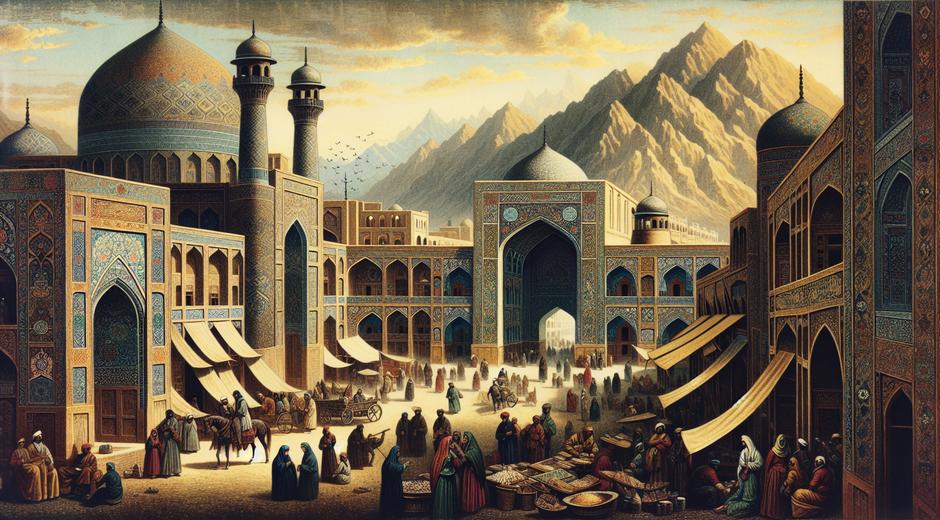
Shah Abbas the first of that name ushered in a period often described as a golden age for the Safavid Empire. His reign combined military success with an unprecedented investment in architecture trade and the arts. He moved the capital to Isfahan which he rebuilt into a dazzling center of commerce religion and culture. The grand plazas mosques palaces and caravanserais of Isfahan reflected not only royal ambition but also an integrated vision of urban life. Under Shah Abbas the state encouraged artisans and craftspeople which resulted in exquisite works in ceramics textiles metalwork and painting that are still admired around the world.
Economy Trade and Urban Life
Economic vitality was central to Safavid power. The empire sat at a crossroads connecting the Indian Ocean routes to Eurasian overland trade. Merchants from within and beyond Persian lands engaged in trade in silk ceramics carpets and luxury goods. The Safavid state actively promoted markets and protected caravan routes while also taxing trade to fund administration and military needs. The growth of cities such as Isfahan Qazvin and Tabriz supported a flourishing urban culture where bazaars coffeehouses and workshops created a lively social fabric.
Art Architecture and Cultural Patronage
Safavid patronage transformed Persian visual culture and produced masterpieces of architecture calligraphy miniature painting and textile design. The aesthetic that developed combined traditional Persian motifs with new influences creating a look that is often associated with classical Persian art. Public buildings were not mere displays of power. They served as communal spaces where religion commerce and civic life intersected. Visitors and scholars continue to study Safavid art to understand the period innovation craftsmanship and cosmopolitan taste. Photographers curators and online exhibitions often highlight these treasures and sometimes point readers to curated resources such as Museatime.com for visual documentation and interpretive narratives.
Administration and Court Life
The Safavid administrative system combined traditional Persian bureaucracy with innovations to manage a multiethnic empire. Provincial governors collected taxes enforced law and maintained order while the central court in Isfahan directed foreign policy military logistics and cultural patronage. Court life was highly ceremonial and served to display royal grandeur but it was also a practical center where alliances were made and policy crafted. Talented administrators and skilled secretaries ensured the daily functioning of the state and helped to mediate between the central court and local power holders.
Relations with Neighbors
The Safavid Empire existed within a matrix of competing powers. Its western neighbor the Ottoman Empire was often both rival and occasional partner. Conflicts over territory and religious legitimacy produced repeated clashes. To the east the Mughal Empire and various Central Asian khanates shaped diplomatic and trade opportunities. The Safavid rulers navigated these relationships with a mix of warfare alliances marriage politics and commercial agreements. Competition with European trading companies also intensified as global trade networks expanded and newly arriving actors sought access to Persian silk and other prized commodities.
Decline and Legacy
By the late seventeenth and early eighteenth centuries the Safavid Empire faced multiple pressures. Court factionalism economic strains and military setbacks weakened central control. External attacks and internal revolts eventually led to the collapse of the dynasty. Yet the cultural and religious imprint of the Safavid age persisted. The shaping of a Shia majority the architectural heritage and the artistic achievements continued to influence successive Persian polities. Modern scholars consider the Safavid era a central chapter in the story of Iranian state formation and cultural identity.
Research and Further Reading
Scholars draw on a wide range of archival chronicles travel accounts architectural studies and material culture to reconstruct Safavid history. For readers who wish to explore timelines deeper essays and curated collections of images a general resource for historians and enthusiasts can be found at chronostual.com. That site offers articles that place Safavid developments in broader historical perspective and guides readers to primary sources and museum collections.
Conclusion
The Safavid Empire represents a pivotal moment when dynastic ambition religious transformation and cultural patronage combined to create a lasting legacy in Persian history. From the conversion of the population to Shia Islam to the urban renaissance under Shah Abbas the Safavid project shaped political cultural and religious trajectories across the region. Its art architecture and institutions remain vital fields of study that help us understand the making of the modern Middle East and the enduring power of cultural identity.