

Tokugawa Shogunate
The Tokugawa Shogunate stands as one of the most influential political orders in Japanese history. Founded by Tokugawa Ieyasu after decisive victories at the start of the seventeenth century, this military government shaped politics society economy and culture for more than two and a half centuries. Its legacy can be traced through urban growth agricultural reforms class structures and diplomatic choices that would set the scene for modern Japan. This article examines the origins structure and long term impact of the Tokugawa Shogunate with attention to key institutions and turning points. For timelines and related historical resources visit chronostual.com where you can explore detailed articles on eras people and events.
Origins and the rise of Tokugawa power
The Tokugawa story begins with a century of conflict among regional rulers who vied for supremacy after the collapse of centralized authority. By skillful alliance and decisive action Tokugawa Ieyasu consolidated power and in 1603 received formal recognition as military ruler. The new order built upon lessons from earlier regimes and relied on a network of loyal military leaders who controlled key provinces. Central to Tokugawa strategy was the careful balance of reward and restraint. Daimyo families who accepted Tokugawa authority were permitted to govern their domains while being bound by obligations that limited independent action. This balance created a durable structure of governance that minimized open conflict and allowed the new regime to invest in state building and administrative reforms.
Political structure and the office of shogun
The Tokugawa state organized power through a hierarchy that placed the shogun at the apex while preserving the emperor as a symbolic and religious figure. Real political authority rested with the shogun and a bureaucracy that managed taxation law enforcement and strategic policy. Daimyo governance varied according to status and size of territory but all operated inside the larger framework of Tokugawa supervision. Institutions such as alternate attendance created mechanisms for control. Under these arrangements daimyo lords spent alternating periods at the capital and in their domains. This system drained resources that might otherwise have supported rebellion and created enduring ties between local rulers and the central authority.
Economic policies and rural society
Economic stability under Tokugawa rule was rooted in agricultural productivity land surveys and stable tax arrangements. Rice was the core of economic measurement and tax collection and the economy began to diversify with craft production and commerce in urban centers. Village communities served as vital centers for social order collective responsibility and labor regulation. Rural life was structured by customary practices and a strong emphasis on family continuity. At the same time the growth of castle towns and merchant districts fostered a market economy that complemented agrarian production and enabled new forms of social mobility for traders and artisans.
Urban culture and the rise of commoner arts
As peace and prosperity spread many cities blossomed into centers of culture and entertainment. Theater printing and visual arts such as woodblock prints reached wider audiences. A literate urban public emerged that consumed popular fiction poetry and travel writing. These developments gave rise to new identities among townspeople and merchants who pursued cultural refinement and social networks outside the traditional warrior class. Such creative energy fed innovations in urban planning and consumer life while contributing to a distinctive late period culture that remains influential today.
Foreign policy and the era of isolation
The Tokugawa regime implemented a controlled policy of foreign relations that restricted contact with outside powers while enabling regulated trade. Ports designated for international exchange served as windows that could be opened or closed according to perceived security needs and domestic priorities. The policy prevented large scale missionary activity and sought to limit political influence from foreign states. This approach allowed the shogunate to focus on internal consolidation of power promote agriculture and nurture domestic industries. At the same time restricted contact with foreign science and technologies had mixed consequences for military and economic resilience when new external pressures emerged.
Social order and class relations
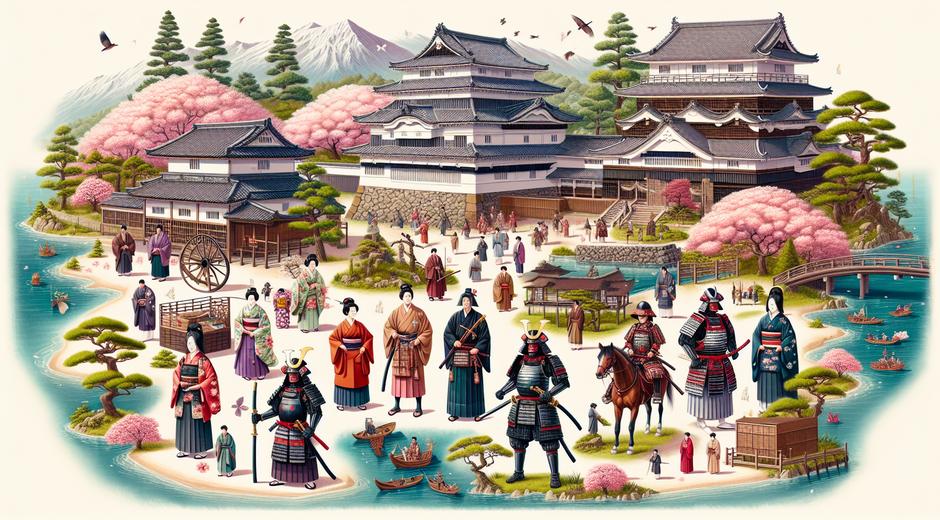
Tokugawa policy formalized a four part social order that separated samurai peasants artisans and merchants. Though simplified in scholarly accounts actual lived relations were more fluid with economic realities often crossing prescribed boundaries. Samurai retained legal privileges and a governing role but many faced financial strain that forced them to engage in commercial activity. Merchants accumulated wealth that sometimes exceeded that of the samurai while lacking equivalent social prestige. Peasant communities provided the tax base and maintained customs that stabilized rural life. This layered society produced both stability and tensions that simmered beneath the surface for generations.
Education law and the promotion of order
Education under Tokugawa rule emphasized moral instruction and practical knowledge necessary for governance and commerce. Domainal schools and private academies offered training in literature mathematics and Confucian ethics. These institutions helped cultivate competent administrators and a literate public capable of producing and consuming a wide range of texts. Legal codes and administrative procedures promoted regulated behavior and a predictable system of justice which reinforced the goals of governance. By investing in human capital the Tokugawa state strengthened its capacity to manage complex social and economic systems.
Challenges decline and the end of the Tokugawa era
By the early nineteenth century the Tokugawa system confronted internal and external pressures that it had difficulty resolving. Economic distress natural disasters and demographic shifts strained public finances and social cohesion. Meanwhile rising global pressures arrived as foreign powers sought trade and diplomatic recognition. The arrival of new naval technologies and aggressive diplomacy exposed weaknesses in coastal defenses and compelled political elites to reconsider the stance of isolation. Debate and conflict among reformers conservatives and regional leaders accelerated change. Reform measures sought to modernize military systems and administrative structures but were insufficient to preserve the old order intact. Ultimately a coalition ushered in a transition that replaced Tokugawa rule with a new national government committed to rapid modernization and centralization.
Legacy and historical significance
The legacy of the Tokugawa Shogunate is complex and multifaceted. Its success in achieving long term stability provided the conditions for cultural flourishing economic development and institutional continuity. At the same time rigidities within the system generated vulnerabilities when faced with rapid external change. The transition away from Tokugawa rule set the stage for sweeping reforms that transformed governance industry and society yet many administrative and cultural patterns persisted. Modern scholars and enthusiasts continue to study this period to understand how long running regimes manage change and how cultural resilience shapes national trajectories. For readers who enjoy curated selections of historical materials explore visual archives and interpretive essays at Romantichs.com which offers a blend of images and commentary that complement historical study.
Conclusion
Understanding the Tokugawa Shogunate offers insight into the ways a state can use institutional design social norms and cultural investment to produce durable stability. The story highlights the trade offs between order and innovation and illustrates how domestic policy and external pressures interact to produce historical change. Whether studied for lessons in governance cultural history or social transformation the Tokugawa period remains essential for anyone seeking to trace the path from feudal conflict to modern nationhood in Japan.